


In iGaming, payment experience has moved from the background to the centre of competitive differentiation. As player acquisition costs continue to rise and regulatory scrutiny tightens, operators are being judged less on promotional intensity and more on how reliably they handle money at critical moments. By 2026, payments are no longer a neutral utility. They are a visible expression of operational discipline and trustworthiness.
Player expectations have evolved quickly. Instant bank transfers, real-time notifications, and seamless app-based payments have become standard in everyday digital finance. When gambling platforms fail to meet those benchmarks, the gap is immediately felt. Slow confirmations, unclear withdrawal timelines, or inconsistent rules now signal more than inconvenience; they raise questions about competence and fairness.
This shift matters because payments intersect directly with player emotion and decision-making. Deposits frame the first impression of the platform, while withdrawals define whether that impression holds under pressure. Operators that manage these touchpoints with clarity and predictability tend to retain players longer and attract less regulatory attention.
As competition intensifies across regulated markets, payment experience is emerging as a quiet but powerful advantage that influences conversion, retention, and long-term operational stability without ever appearing in a marketing headline.
How Player Payment Expectations Have Matured Since 2023
Since 2023, player expectations around payments have not just risen, they have narrowed. Where players once tolerated variation between operators, they now expect a baseline level of speed, clarity, and reliability that feels consistent with the wider digital economy. iGaming platforms are no longer compared only with each other; they are measured against banking apps, wallets, and instant transfer services that have trained users to expect near-immediate outcomes.
This change has been shaped less by gambling innovation and more by everyday financial behaviour. Players now arrive with ingrained assumptions about how payments should behave. When those assumptions are broken, frustration sets in quickly, often before gameplay even begins.
Across markets, expectations have converged around a few non-negotiables:

Fast confirmation of deposits

Predictable handling of withdrawals

Clear communication when delays occur
What has shifted most sharply is interpretation. Delays are no longer seen as technical inconvenience. They are read as signals. A slow deposit suggests fragility. An unclear withdrawal timeline suggests risk. Silence during payment checks suggests avoidance. In this environment, payment behaviour becomes shorthand for how seriously an operator takes its responsibilities.
Crucially, players are also more aware of choice. Switching costs are low, and alternatives are abundant. When payment experience falls short, many players do not complain, they simply disengage. That silent churn is why iGaming payments trends are increasingly discussed in retention and product meetings rather than only in finance or risk teams.
The operators performing best in 2026 are not those offering the most methods, but those delivering payment experiences that feel deliberate, controlled and familiar, even under scrutiny.
Deposits as the First Trust Signal
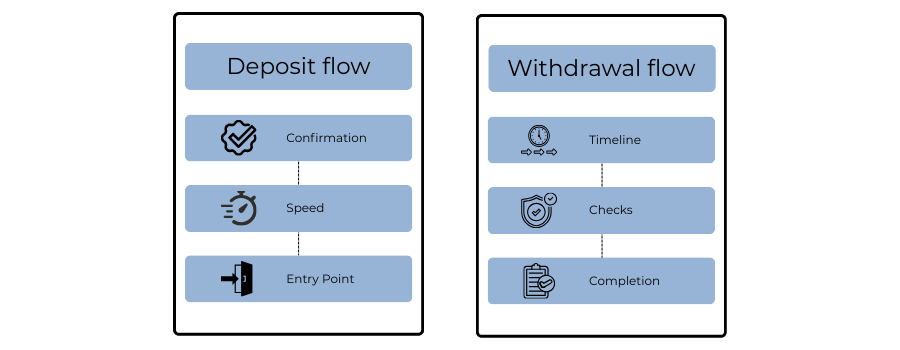
The deposit journey is where an iGaming operator first proves that it can be trusted with a player’s money. Before gameplay, bonuses, or odds have any chance to matter, the payment flow establishes whether the platform feels stable and professionally run. In 2026, that initial interaction carries more weight than ever.
Deposits function as the gateway to engagement. A player who encounters friction at this stage rarely waits around to see if the experience improves. Failed authorisations, unclear error messages, or delayed confirmations interrupt momentum and often lead to session abandonment. Even when a deposit eventually succeeds, the hesitation it creates can shorten the session or reduce willingness to deposit again.
What players respond to most strongly is not speed alone, but certainty. A deposit that completes quickly and confirms clearly reinforces confidence. A deposit that behaves unpredictably undermines it. This is why payment experience at the deposit stage has become tightly linked to early conversion and first-time depositor success.
From a retention perspective, deposits also set expectations for everything that follows. Players implicitly assume that withdrawals will mirror deposits in clarity and predictability. When that assumption is later broken, disappointment is amplified. In that sense, deposits do more than enable play; they define the benchmark against which the entire payment relationship will be judged.
Withdrawals as the Decisive Trust Moment
If deposits create the first impression, withdrawals determine whether that impression survives. The psychological difference between paying in and getting paid out is substantial. Withdrawals occur at moments of heightened expectation, and they carry emotional weight that deposits rarely do. In 2026, this makes withdrawal experience the most influential payment touchpoint in the player journey.
Players may tolerate friction when funding an account, but their tolerance drops sharply when accessing winnings. Delays that felt acceptable on deposits feel personal on withdrawals. Unclear timelines quickly translate into suspicion, even when checks are legitimate. This is why withdrawal performance has become a stronger predictor of long-term trust than almost any other operational metric.
The most damaging issues are rarely outright failures. They are points of uncertainty that leave players guessing. Manual reviews without explanation, payment method restrictions discovered late, or shifting completion estimates all create the sense that control has been lost. Once that perception takes hold, confidence erodes rapidly.
Operators that perform well at this stage tend to design for predictability rather than speed at any cost. They communicate expected timeframes before a withdrawal is requested, reinforce status changes as they occur, and avoid introducing new conditions mid-process. As a result, players are more likely to wait calmly, rather than escalate concerns or disengage.
Over time, predictable withdrawals influence behaviour in measurable ways. Players who trust that funds will arrive as promised are more willing to continue playing, less likely to open support tickets, and less inclined to voice complaints externally. This is where player retention payments strategy becomes tangible: trust earned during withdrawals directly shapes repeat play and lifetime value.
Payment Transparency as a Retention Mechanism
In modern iGaming environments, transparency has become the stabilising force that holds payment experience together. It does not remove friction, but it determines how friction is perceived. By 2026, players are far less reactive to delays themselves than to uncertainty around those delays.
Transparency starts with expectation-setting. When timelines, checks, and conditions are explained before a transaction begins, players are mentally prepared for what follows. When that context is missing, even routine processes can feel adversarial. This is why vague messaging such as processing or under review often causes more frustration than longer but clearly defined waits.
Effective payment transparency focuses on visibility rather than justification. Players do not need to understand internal risk logic, but they do need to know where they are in the process and what happens next. Clear status updates, confirmation messages, and proactive notifications reduce the psychological gap between action and outcome.
From a retention perspective, this matters most during withdrawals. Uncertainty at this stage drives anxiety, and anxiety drives churn. Operators that invest in clear, consistent communication during payment journeys tend to see fewer abandoned accounts and fewer payment-related complaints. Over time, players learn that even when delays occur, they are managed openly rather than defensively.
Transparency also has a quiet operational benefit. When players are informed, they escalate less. Support teams spend less time answering repetitive queries, and compliance teams face fewer reactive interventions. In this sense, payment transparency operates as both a player-facing trust mechanism and an internal efficiency lever, one that supports retention without relying on incentives or promotions.
Consistency, Regulation and PSP Trust
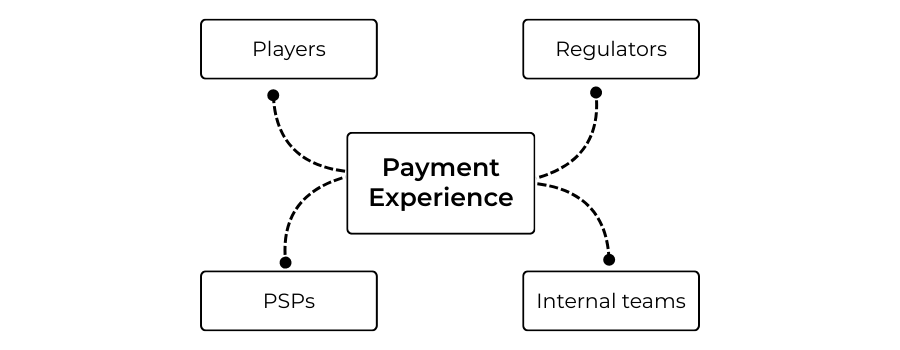
Payment experience is not judged only by players. By 2026, regulators and payment service providers increasingly read payment behaviour as evidence of how well an iGaming operator governs itself. Inconsistent or opaque payment journeys are rarely treated as isolated UX issues; they are interpreted as symptoms of deeper operational weakness.
Where players react emotionally, regulators and PSPs react structurally. They look for patterns not incidents.
Why Consistency Matters Beyond the Player
From a regulatory perspective, payments are one of the few areas where consumer outcomes are measurable and comparable. Timelines, reversals, complaints and disputes all leave an audit trail. When those signals show unpredictability or frequent escalation, scrutiny tends to follow.
PSPs apply a similar lens, but with commercial consequences. For them, payment experience functions as a proxy for risk discipline. An operator whose payment rules shift by market, device, or method is harder to support, harder to defend in disputes and harder to scale safely.
What matters most is not perfection, but coherence. Operators are expected to have differences by geography or method. They are not expected to surprise players with those differences mid-journey.
How Payment Experience Is Interpreted by External Stakeholders
| Signal observed | Typical interpretation |
| Frequent withdrawal complaints | Weak expectation-setting or under-resourced operations |
| Method-specific disputes | Inconsistent rules or poor player communication |
| High manual intervention rates | Immature automation or unclear risk thresholds |
Once these patterns appear, conversations change. Reviews become more frequent. Controls tighten. In some cases, processing terms are adjusted quietly rather than publicly explained.
Long-Term Impact on Processing Stability
Operators that deliver consistent, well-communicated payment experiences tend to enjoy more stable PSP relationships. Predictable behaviour reduces emergency escalations and builds confidence that issues will be handled before they become systemic.
The inverse is also true. Payment inconsistency accumulates risk slowly, then surfaces abruptly, often through sudden limits, additional reserves, or method removals. By that point, the problem is rarely speed or volume. It is trust.
By 2026, payment experience sits at the intersection of player retention, regulatory confidence and PSP support. Operators that recognise this convergence early are far better positioned to grow without disruption.
Conclusion
By 2026, payment experience has become one of the clearest signals of how seriously an iGaming operator treats its players, partners, and regulators. What was once viewed as a backend function is now embedded directly in the player journey, shaping first impressions, defining trust at withdrawal and influencing whether players choose to stay or leave quietly.
Operators that perform well in this environment share a common approach. They design deposits to feel controlled and predictable, treat withdrawals as moments of heightened responsibility, and communicate clearly when friction is unavoidable. They also understand that consistency matters more than novelty. A smaller number of well-governed payment flows builds far more confidence than a fragmented collection of options.
Crucially, payment experience now operates on multiple levels at once. Players judge it emotionally. Regulators assess it structurally. PSPs evaluate it operationally. When these perspectives align positively, operators benefit from stronger retention, fewer escalations, and greater processing stability.
As competition intensifies and scrutiny increases, payment experience is no longer an invisible utility. It is a competitive advantage that compounds quietly over time. For iGaming operators looking to grow sustainably in 2026, the way money moves through the platform may matter as much as the games themselves.
FAQs
1. Why is payment experience becoming more important than bonuses or promotions in iGaming?
As acquisition costs rise, operators are increasingly judged on reliability rather than incentives. Bonuses may attract attention, but payment experience determines whether players trust the platform enough to stay. Poor payment journeys often negate the perceived value of promotional offers.
2. How do payment delays affect player behaviour even when funds eventually arrive?
Delays without clear communication create uncertainty, which damages confidence. Even if the payment completes, players may reduce future spend, withdraw earlier, or stop playing altogether. The behavioural impact often appears as silent churn rather than direct complaints.
3. Are instant payments always better for player retention?
Not necessarily. Predictability matters more than speed. Players are more likely to tolerate a known 24-hour timeline than an “instant” promise that fails intermittently. Consistent outcomes build trust faster than occasional speed.
4. How does payment experience influence regulatory risk?
Regulators monitor complaints, disputes, and payment timelines as indicators of consumer harm. Persistent friction or unclear communication around payments can trigger increased scrutiny, even if no single incident appears severe.
5. Why do withdrawals have a stronger impact on trust than deposits?
Withdrawals involve accessing winnings, which carries emotional and financial significance. Any uncertainty at this stage is interpreted more critically. Players often judge the entire platform based on how withdrawals are handled.
6. Can payment transparency reduce support costs?
Yes. Clear timelines, status updates, and proactive notifications significantly reduce where is my money? queries. This allows support teams to focus on genuine issues rather than repetitive reassurance.
7. How do PSPs use payment experience to assess iGaming operators?
PSPs look at disputes, reversals, complaint volume, and manual intervention rates. Poor payment experience is often treated as a signal of operational immaturity or elevated risk, affecting long-term processing stability.
8. Is offering more payment methods always beneficial?
Only if those methods are governed consistently. A wide range of poorly integrated options can create confusion and increase risk. Fewer, well-managed methods often deliver a better overall experience.
9. How does inconsistent payment behaviour across devices affect trust?
Players expect the same rules and outcomes whether they use mobile or desktop. Differences in confirmation, timelines, or messaging can make the platform feel unreliable or fragmented.
10. What is the biggest mistake operators make when improving payment experience?
Focusing on speed alone. Without clear communication, consistent rules, and predictable outcomes, faster payments do not translate into higher trust or retention.