


When merchants think about wallet-led payments in Africa, the comparison point is often East Africa. That instinct is understandable. East Africa has shaped much of the global conversation around mobile money, digital wallets and everyday non-card payment behaviour. But that same comparison can become a strategic mistake when merchants try to apply it too quickly to Francophone Africa. The problem is not that wallet-led acceptance is absent in Francophone markets. The problem is that the payments environment is being shaped by a different mix of forces.
In Francophone West and Central Africa, wallet growth sits alongside regional central-bank infrastructure, interoperability initiatives, cross-border coordination questions and a broader push to reduce cash dependence. AfricaNenda’s 2025 and 2026 pieces place regional platforms such as BCEAO’s PI-SPI and GIMACPAY inside a wider integration story, while BCEAO and BEAC materials show that regional payment-system design is not theoretical. It is part of how these markets are actually being organised.
For merchants, that distinction matters in practical ways. It affects how wallet-led acceptance should be evaluated, how regional scale should be interpreted and how opportunity should be separated from simplicity. Francophone Africa in 2026 is not an East Africa replay in another language. It is a different payment environment that requires a different merchant lens.
- Francophone Africa cannot be understood as a simple extension of East Africa’s wallet story
- The regional payments layer matters more here than many merchants realise
- Wallet-led acceptance in Francophone Africa is tied to cash reduction as much as digital convenience
- Why cross-border logic shapes acceptance more than many merchants expect
- Wallet-led does not mean merchant-simple
- WAEMU and broader Francophone markets should not be treated as one identical acceptance environment
- What merchants should actually evaluate before launching wallet-led acceptance beyond East Africa
- Conclusion
- FAQs
Francophone Africa cannot be understood as a simple extension of East Africa’s wallet story
The easiest mistake a merchant can make is to assume that “wallet-led Africa” is one broad pattern with local variations. That assumption usually begins with a real observation: mobile-led payments matter across multiple African markets. But it becomes misleading when it treats every regional payments environment as if it is driven by the same infrastructure logic.
East Africa is often discussed through the visibility of wallet-led consumer behaviour and the strength of mobile money in everyday life. Francophone Africa certainly has its own wallet and mobile payment momentum, but the merchant story is not built around the same shorthand. It is shaped more visibly by regional monetary unions, regional payment-system structures and central-bank-led efforts around interoperability and financial inclusion. AfricaNenda’s integration piece is useful precisely because it frames African payment progress through interoperability and digital public infrastructure rather than through consumer app adoption alone.
This matters because merchants do not enter “wallet adoption.” They enter payment systems. The relevant question is therefore not whether wallet-led usage exists, but what kind of architecture sits behind it. In Francophone Africa, that architecture often includes a stronger regional layer than many merchants expect at first glance. That changes how acceptance should be read, how scaling assumptions should be formed and how local opportunity should be translated into payment-stack design.
The regional payments layer matters more here than many merchants realise
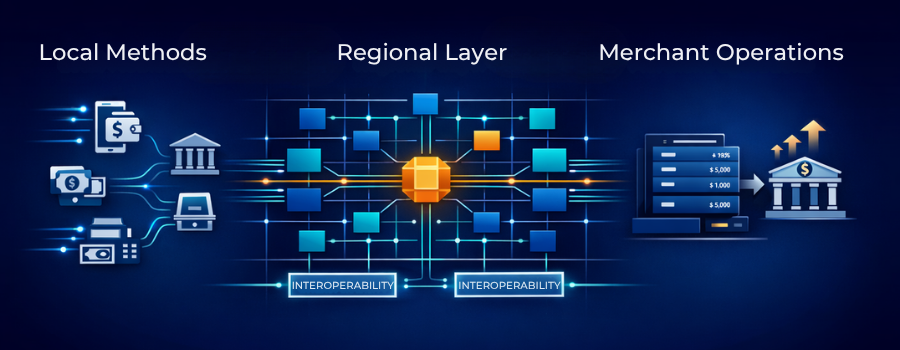
One of the most important things merchants need to understand about Francophone West Africa is that the region cannot be read only as a set of separate national payment-method choices. The regional layer matters more than many outside merchants assume.
BCEAO’s official material makes this especially clear in the WAEMU/UEMOA context. STAR-UEMOA is described by BCEAO as a regional real-time gross-settlement system intended for transactions of systemic scope, with objectives including faster payments, lower transaction administration costs, regional market integration and risk management. That is a structural clue. It shows that the region’s payment environment has long had a coordinated backbone rather than a purely national patchwork.
The regional picture becomes even more important when digital financial services are added. BCEAO annual reports describe a multi-year interoperability initiative for digital financial services, covering access conditions, transaction-processing rules, participant obligations, customer protection and guarantee mechanisms for interoperable transactions. That means wallet-led acceptance in WAEMU is not just a question of which wallet products consumers use. It also sits inside a central-bank-led attempt to make digital financial services interact more coherently across institutions and markets.
Why WAEMU changes the merchant lens
For merchants, WAEMU changes the lens because it encourages a different type of market reading. Instead of asking only which local wallet brands or domestic methods matter in one country, merchants also need to ask how the regional payment environment shapes movement between institutions, future interoperability and the meaning of scale across more than one market.
This does not mean the region is frictionless or fully unified. It means merchants should avoid reading Francophone West Africa through the same logic they might use in a more fragmented, purely national method landscape. A wallet-acceptance decision in WAEMU is more likely to be shaped by regional infrastructure and regulatory coordination than many first-time entrants expect. The World Bank’s WAEMU note reinforces this by describing STAR-UEMOA as being at the heart of the regional payment system and linking that regional structure to electronic-payment growth and financial inclusion.
That regional layer is one of the biggest reasons the East Africa comparison becomes weak so quickly. The issue is not whether wallets matter. The issue is that the merchant decision sits inside a more visibly structured regional environment.
Wallet-led acceptance in Francophone Africa is tied to cash reduction as much as digital convenience
A second mistake merchants make is to read wallet-led growth only as a story about digital convenience or consumer preference. In Francophone Africa, that interpretation is often too narrow. A great deal of the payment transition still needs to be understood through the role of cash and the economic pressure to reduce cash dependence.
AfricaNenda’s Beyond the Banknote article is especially useful because it frames cash-heavy economies as costly and inefficient. It argues that digital payments matter because they improve economic efficiency, make transactions more visible and reduce the frictions that come with cash-dominant circulation. That framing matters because it shifts the merchant lens away from which app is popular? and toward “which acceptance rails help a market move beyond cash-heavy operating constraints?”
This changes how wallet-led acceptance should be interpreted. In some Francophone contexts, the opportunity is not simply that customers like wallets. It is that digital wallet and e-money acceptance can sit inside a broader move toward more formal, more visible and more manageable payment behaviour. In other words, wallet-led acceptance is not only a consumer experience story. It is also part of a commerce-modernisation story.
The merchant implications of cash-heavy environments are usually practical before they are conceptual:
- Slower circulation of value
- Weaker transaction visibility
- Higher operating friction
- Lower formal traceability of payments
That is why merchants should not treat wallet-led acceptance in Francophone Africa as a pure fintech-adoption narrative. It is also part of a broader transition away from the inefficiencies of cash-heavy trade and settlement behaviour. Merchants that understand this will read wallet opportunities more clearly than merchants who treat it only as a front-end method trend.
Why cross-border logic shapes acceptance more than many merchants expect
Merchants often think of acceptance as a local problem. They ask which payment methods customers use, which providers matter in the market and what the checkout should display. Those questions are necessary, but in Francophone Africa they are not always sufficient because cross-border structure influences acceptance more than many merchants initially expect.
AfricaNenda’s financial-integration and regulatory-harmonisation pieces both make this point. The 2025 article argues that Africa’s next phase of payment development depends on deeper interoperability, including wallet-to-bank, bank-to-wallet and cross-border instant-payment connectivity. The 2026 article adds that cross-border payments remain cumbersome because licensing, supervision and payment-service rules differ across countries, and it argues that alignment on regulation and trust frameworks is essential for effective cross-border PSP participation. For merchants, that means acceptance design cannot always be separated neatly from regional architecture and policy alignment.
Acceptance is local, but payment architecture is often regional
This is the central tension merchants need to understand. Checkout is still local in the sense that customers pay in familiar ways inside local markets. But the infrastructure environment behind that checkout may be increasingly regional in how it is governed, connected or scaled.
That matters in at least three ways. It affects how merchants think about future expansion across neighbouring Francophone markets. It affects how payment movement and settlement should be interpreted once flows extend beyond one country. And it affects whether wallet-led acceptance in one market should be seen as a local tactic or as part of a wider regional strategy.
This point should not be overstated. Merchants are not being asked to treat every Francophone launch as a cross-border payments project from day one. The better conclusion is more measured: in this region, payment-system design and future scale are more likely to be shaped by regional coordination questions than a merchant relying on the East Africa comparison might assume. That alone changes how launch planning should be done.
Wallet-led does not mean merchant-simple
Another weak assumption is that wallet-led markets automatically become easier for merchants once the right local methods are added. That is rarely true. Wallet-led opportunities can be real and still sit inside an operationally uneven environment.
This is where merchants need to be careful. A region may show strong policy support for digital payments, meaningful progress on interoperability and clear pressure to reduce cash use, yet still require disciplined evaluation of how merchant operations will actually work. Wallet-led acceptance is not the same thing as merchant simplicity.
The main questions remain practical. Can the merchant see the settlement clearly enough to plan cash flow? Is reconciliation likely to be manageable across providers and institutions? Is participation broad enough to make the environment commercially useful rather than theoretically promising? Is interoperability mature enough that wallet-led opportunity can be converted into stable merchant operations? These are the issues that separate a promising market narrative from a workable payment strategy.
A merchant entering Francophone Africa should still evaluate at least four things carefully:

Settlement visibility

Reconciliation quality

Provider participation

Interoperability maturity
That is why this article should not romanticise wallet-led acceptance. The stronger model is to see opportunity and operational caution at the same time. Francophone Africa may offer meaningful digital-payment growth, but that does not remove the need for disciplined payment-stack design.
WAEMU and broader Francophone markets should not be treated as one identical acceptance environment
At the same time, merchants should avoid reacting to regional infrastructure by assuming the whole Francophone space behaves as one uniform payments market. That would create a different but equally serious mistake.
WAEMU/UEMOA has a specific regional structure shaped by BCEAO and its payment-system work. Central Africa has its own regional infrastructure story through BEAC and GIMACPAY. BEAC states that GIMAC supports interbank payments and, through GIMACPAY, processes card, e-money/mobile money and transfer transactions. Its 2022 payments report says GIMACPAY processed more than 10 million transactions in that year for a cumulative value above 395 billion CFA francs. Those are important signals of regional architecture, but they do not imply identical merchant conditions across every country in the zone.
This is an important balancing point for merchants. The regional layer matters enough that it cannot be ignored, but local-market discipline still matters enough that it cannot be replaced by broad regional optimism. A merchant that looks only at national wallet labels will under-read the architecture. A merchant that looks only at regional institutions will over-read the simplicity.
The stronger interpretation is that Francophone Africa combines regional coordination with uneven local realities. That makes it more structured than many merchants expect, but not uniform enough to treat as one fully standardised acceptance environment. That is why a merchant framework works better here than a country list or a single “Francophone Africa” summary statement.
What merchants should actually evaluate before launching wallet-led acceptance beyond East Africa
The strongest merchant response is not to ask whether Francophone Africa has wallets, or whether it resembles East Africa enough to justify a familiar playbook. The stronger response is to evaluate whether wallet-led acceptance actually fits the payment environment the business is entering.
The stronger merchant lens is infrastructure fit, not wallet familiarity alone
That means starting with architecture, not with app awareness or brand recognition. Merchants should ask how the regional payments layer influences the target market, how cash reduction shapes demand for digital acceptance, how cross-border structure may affect future scale, and whether the operational foundations behind wallet-led payments are strong enough for the business model.
A useful way to frame the decision is to keep four priorities in view:
- Read the regional architecture first
- Test how wallet acceptance fits the real payment environment
- Assess cross-border and settlement implications early
- Separate wallet opportunity from operational readiness
This is where the topic becomes most useful for Payment Mentors readers. The goal is not to offer a broad regional narrative. It is to show that Francophone Africa requires merchants to think beyond the familiar East African wallet template and toward a more infrastructure-aware acceptance strategy.
The merchants most likely to do well in this environment will be the ones that recognise two things at once: first, that wallet-led opportunity is real and increasingly important; second, that the region’s payment logic is being shaped by central-bank infrastructure, interoperability agendas and cash-reduction economics in ways that require a different entry lens.
Conclusion
Francophone Africa in 2026 should not be read as a simple continuation of East Africa’s wallet story. Wallet-led acceptance matters, but it sits inside a payment environment more visibly shaped by regional institutions, interoperability work, cross-border coordination and the economics of moving away from cash.
That means merchants need a different lens. Instead of asking only which wallet methods are popular, they need to understand how regional payment architecture influences acceptance, how operational readiness affects scale and how local-market conditions sit inside wider Francophone payment structures.
The stronger merchants will not be the ones that simply repeat an East Africa playbook in a new regional context. They will be the ones that understand payment architecture first, acceptance labels second, and use that understanding to design wallet-led expansion with more precision.
FAQs
1. Why is East Africa the wrong default comparison for Francophone Africa payments?
Because Francophone Africa’s payments environment is shaped more visibly by regional infrastructure, central-bank coordination and interoperability initiatives. Wallet-led acceptance still matters, but the merchant story is less about copying an East Africa mobile-money model and more about understanding a different regional payments architecture.
2. Does wallet-led acceptance matter in Francophone Africa?
Yes, but it should not be read only as a consumer wallet-adoption story. In many Francophone markets, wallet-led acceptance sits alongside broader efforts to reduce cash dependence, improve payment visibility and support more formal digital transaction environments.
3. Why does the regional payments layer matter so much in WAEMU/UEMOA?
Because merchants are not entering only separate national payment-method markets. WAEMU has regional payment infrastructure and interoperability work that influence how payment systems are organised. That makes regional payment architecture an important part of merchant acceptance planning in Francophone West Africa.
4. What is the practical merchant meaning of regional infrastructure in Francophone Africa?
It means acceptance decisions cannot be based only on local wallet familiarity. Merchants also need to understand how regional systems, interoperability efforts and regulatory coordination shape settlement, future scale and the broader operating environment behind wallet-led payments.
5. Why is cash reduction part of the wallet-led acceptance story?
In many Francophone markets, digital payment growth is also a response to the frictions of cash-heavy trade. Wallet-led acceptance can support better transaction visibility, more formal payment behaviour and less operational dependence on cash, which makes it more than just a convenience or app-adoption trend.
6. Does cross-border logic matter even if a merchant is launching locally?
Yes, because regional policy alignment and payment infrastructure can affect how merchants interpret future expansion, settlement behaviour and payment movement. Checkout may be local, but the structure behind that checkout can still be shaped by regional and cross-border payment-system design.
7. Does wallet-led mean simpler operations for merchants?
Not necessarily. Wallet-led opportunities can still sit inside an uneven operating environment. Merchants need to test settlement visibility, reconciliation quality, provider participation and interoperability maturity rather than assuming that adding wallet methods automatically creates a simple merchant model.
8. Should merchants treat Francophone Africa as one single uniform payments market?
No. There are important regional structures in both West and Central Africa, but local market conditions still differ. The stronger approach is to recognise the regional architecture while still keeping market-by-market discipline around merchant readiness, customer behaviour and operating conditions.
9. What is the difference between WAEMU/UEMOA and broader Francophone Africa in payment strategy?
WAEMU/UEMOA has a particularly important regional layer because of BCEAO-led infrastructure and interoperability work. Broader Francophone Africa includes other regional structures, such as Central Africa’s payments environment, so merchants should avoid assuming that all Francophone markets behave identically even when regional coordination exists.
10. What is the main strategic mistake merchants make in this region?
A common mistake is treating Francophone Africa as either a simple East Africa-style wallet market or a uniform Francophone bloc. Both views are too narrow. The stronger merchant model is to assess regional architecture, cash-reduction context, operational readiness and local acceptance behaviour together.
11. What should merchants evaluate before launching wallet-led acceptance in Francophone Africa?
Merchants should evaluate the regional payments layer, how strongly wallet usage fits the real payment environment, what cross-border and settlement implications may emerge, and whether the business is operationally ready to manage the reporting and reconciliation demands behind wallet-led acceptance.
12. What is the strongest merchant lens for Francophone Africa payments in 2026?
The strongest lens is infrastructure fit rather than wallet familiarity alone. Merchants should understand how regional payment architecture, interoperability agendas, cash-reduction dynamics and local operating conditions interact before deciding how wallet-led acceptance should be designed and scaled.